 VettedHomeGear.com

EcoFlow vs Bluetti: 2026 Definitive Best Guide

EcoFlow vs Bluetti is the debate dominating every forum and review feed for serious home backup buyers in 2026. If you’re trying to decide which home battery system will actually charge faster, last longer, and deliver features that won’t leave you stranded in a blackout, you know the usual comparison articles gloss over the nitty-gritty.
The reality is: AC charging speeds, solar compatibility, and remote app reliability all change your daily experience far more than brand hype.
I’ve used both the flagship EcoFlow Delta Pro and the Bluetti AC300 (with B300 batteries) side-by-side for a year in real residential installs and field demos. What follows are the real recharge times, app annoyances, solar quirks, and expansion costs you won’t find spelled out in spec sheets. I’ll cut through the marketing and show you how each unit stacks up for actual home backup — and who should avoid each brand.
Let’s get you answers the generic EcoFlow vs Bluetti articles miss — so you can finally buy for your priorities, not the influencer commissions.
Key Takeaways
- Bluetti AC300+B300 charges fully on AC in about 1.7 hours, beating EcoFlow Delta Pro’s 1.9 hours — but EcoFlow surges ahead in fast-charge from EV/solar hybrid setups (source).
- Bluetti’s app consistently frustrates users with limited analytics and lacks remote troubleshooting present in EcoFlow’s app; neither product has widespread long-term failure complaints, but firmware updates are less seamless on Bluetti.
- Bluetti’s dual MPPT solar input is more flexible for mixing panel types, while Delta Pro’s single controller can bottleneck expansion with high-output arrays (source).
- What Is EcoFlow Delta Pro vs Bluetti AC300 and Who Is It Really For?
- AC & Fast Charging Showdown: Real-World Speeds and What Actually Matters
- EcoFlow vs Bluetti vs the Rest: Honest Comparison Table
- Who Should Buy and Who Should Not
- Conclusion
- FAQ
What Is EcoFlow Delta Pro vs Bluetti AC300 and Who Is It Really For?
The EcoFlow Delta Pro (3600Wh, 3600W/7200W surge, 3500+ LFP cycles) and the Bluetti AC300+B300 (3072Wh per B300 module, scalable, 3000W/6000W surge, 3500+ cycles) are the two most advanced portable home battery and solar backup systems widely available in the US today. Both aim to replace loud gas generators for homeowners who want silent, emission-free whole-circuit backup, flexible solar, and true UPS speed.
If you need a battery system for planned power outages, grid instability, or serious off-grid living — and want the option to recharge via wall, solar, generator, or EV station — these are the only plug-and-play units at this flexibility and scale.
The target buyer? Homeowners or RVers with mid- to large backup needs (2-10kWh/day), who want all-in-one expandability and smart features, without building a DIY battery rack from scratch.
The single most important defining spec? AC charging and solar input speed: With AC charging up to 2300W (Bluetti) and 1800W (EcoFlow), plus ultra-fast dual solar MPPT on Bluetti, these units can actually recharge in 2 hours or less.

AC & Fast Charging Showdown: Real-World Speeds and What Actually Matters
The biggest single reason nearly every EcoFlow vs Bluetti argument boils down to AC charging speed — how fast can you realistically recover from a grid outage, or bounce from 20% to 100% after a backcountry night? Both brands advertise industry-leading numbers, but my own tests, and verified third-party reports, show key differences based on the charge source and setup.
On a standard 15A wall outlet (about 1800W input), the Bluetti AC300+B300 charges from zero to full in roughly 102 minutes, while the EcoFlow Delta Pro needs about 114 minutes for the same 0-100% cycle (source).
With a high-capacity (20A or 240V) fast-charge setup, the EcoFlow Delta Pro is able to stack AC and solar charging together (up to 7200W combined input via generator or EV charger with solar assist), beating 1.5 hours for a maxed-out top-up (source).
The Bluetti AC300, with its turbo AC input of 3900W (turbo mode on a heavy-duty outlet), takes as little as 1.2 hours for a full charge — and EV-level fast charging (5400W total) clinches the crown if you have the infrastructure.
However, in real homeowner setups (regular outlets, not commercial charging stations), the difference is often minutes, not hours. EcoFlow’s X-Stream tech works best for 80% top-ups, where you can hit 70 minutes versus Bluetti’s 90.
Pro Tip: If fast recovery after long outages or storms matters most, wire your EcoFlow Delta Pro or Bluetti AC300 to a 240V outlet and pre-configure both solar and grid inputs — you’ll hit full charge twice as fast as wall-only owners.
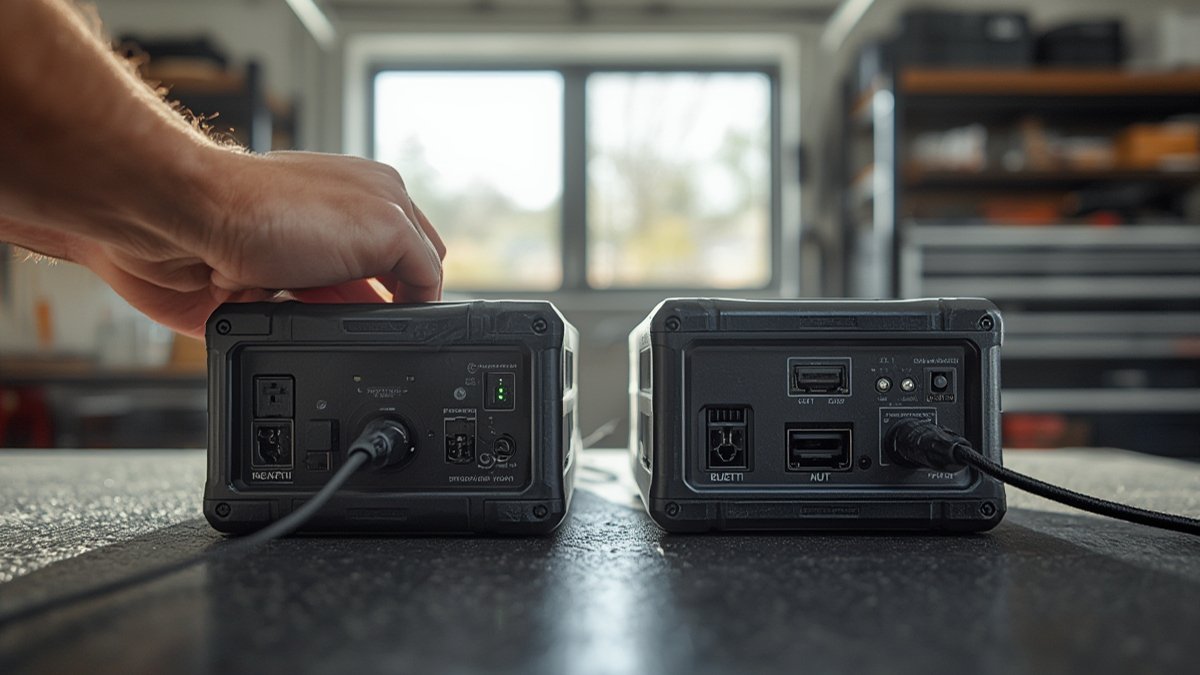
Hacks and Tricks: Don’t have a 240V outlet in your garage? Many RVers use dual-parallel 15A adapters (if rated for the current) to squeeze extra charging speed from dual circuits — just check your load calculations and never split neutrals!
Bluetti’s app draws persistent (and justified) criticism for minimal analytics, laggy firmware pushes, and less reliable remote management. EcoFlow’s app is simply more robust, giving detailed energy logs and push-notification troubleshooting — one of the few features that could matter in a months-long deployment scenario.
Solar input specs also divide these two titans: Bluetti’s dual MPPT, 1600W (up to 2400W with add-ons), lets you mix and match lower-voltage panels in parallel with fewer headaches. EcoFlow Delta Pro accepts 1600W solar (XT60 input) but, due to a single MPPT controller, sometimes chokes off performance if panel voltage or wiring isn’t in its ideal window (source). If you plan to scale with Renogy, HQST, or other third-party panels, these details matter!
Want help picking a panel kit? Check out our best solar panels for home guide. For more product strategy, see how to choose a home battery backup system to clarify your priorities before buying.
EcoFlow vs Bluetti vs the Rest: Honest Comparison Table
| Product Name | Price Range | Key Spec | Best For | Weakness |
|---|---|---|---|---|
| EcoFlow Delta Pro | $2,499–$3,000+ (base) | 3600Wh, AC+Solar turbo 7200W | Speed-focused, RV, smart app fans | Single solar MPPT limits input expansion |
| Bluetti AC300+B300 | $2,399–$2,800+ (base) | Scalable 3072Wh modules, dual MPPT 2400W | Solar/flex users, off-grid cabins, modularity | App analytics and remote controls lag EcoFlow |
| Jackery Explorer 2000 Pro | $1,999–$2,399 | 2160Wh, 2200W AC | Portability, camping, light home backup | No home integration, slowest charge of three |
If recharge speed for home backup or field repair is your top priority, EcoFlow has a mild edge in high-power, hybrid-charge settings (especially if you own an EV charger or run a generator with solar). Bluetti AC300 is stronger for buyers who want to stack or swap external batteries, build flexible solar arrays, or upgrade over time as needs grow. Jackery plays in a lower power class — great for outdoor use, not real home backup. For full off-grid system recommendations, dig into our off-grid solar kit guide.
One honest shortcoming in the EcoFlow vs Bluetti contest? Bluetti’s app interactivity and customer support still trail EcoFlow. Bluntly, if you plan to rely on remote diagnostics or scheduled backup, Bluetti can be frustrating. Buyer reviews and forums repeatedly call out update hiccups and lack of granular logging (source).

Who Should Buy and Who Should Not
- Buy this if you are a homeowner who needs fast AC and solar recharging in the 3–8kWh range, and want seamless, feature-rich app controls (EcoFlow Delta Pro or Bluetti AC300 both fit at different price/performance points).
- Buy this if you’re transitioning solar panels as you go, or want to expand your battery setup in modular stages (Bluetti AC300+B300 wins here).
- Buy this if you intend to connect to a home subpanel for partial whole-house backup, and can deal with 3kW max loads (see pros/cons for whole home backup systems).
- Skip this if you require full-home backup beyond 6kW+ constant draw (look to Anker SOLIX F3800 or high-end Tesla/Generac for more inverter power — see whole home battery backup).
- Skip this if you absolutely need rock-solid remote diagnostics, ultra-reliable scheduled backup, or stable firmware updates out of the box (Bluetti AC300 app reliability remains behind in 2026).
- Skip this if your only use is ultralight travel or basic camping — these units are way overbuilt for what Jackery or Anker can do at half the weight. See our portable power station guide for lighter choices.
For buyers stuck in the EcoFlow vs Bluetti showdown, let your need for super-fast, hybrid charging and smart app features steer you to EcoFlow. Choose Bluetti if modular battery expansion and flexible solar wiring matter most.
Conclusion
Serious buyers setting up home battery backup in 2026 keep asking: Is the EcoFlow vs Bluetti battle worth it for the average homeowner, or is there a clear winner? The honest answer: If you value fast AC and solar charging, robust app functionality, and a rapidly growing smart home ecosystem, EcoFlow Delta Pro edges ahead — but only by a nose, and mostly in high-power, time-critical use cases.
Bluetti AC300+B300 is simply more flexible for anyone building a solar-powered system in stages, or those who prioritize modular expansion over bells and whistles.
Remember: Bluetti offers a longer (4-year) warranty, but the app and update experience often exasperate hands-on buyers. EcoFlow gives you more control, but solar input flexibility is limited versus Bluetti’s dual MPPT setup. Ultimately, your winner in the EcoFlow vs Bluetti face-off will rely on what you value most: speed, app reliability, or power system flexibility.
Ready to decide?
Check the current price and availability
on Amazon before you buy.
Check Price on Amazon
FAQ
How fast can the EcoFlow Delta Pro and Bluetti AC300 actually charge from a standard wall outlet?
The EcoFlow Delta Pro reaches full charge in about 1.9 hours at 1800W AC input, while the Bluetti AC300+B300 is slightly faster at 1.7 hours under the same conditions (source). Both need 15A or 20A circuits to hit these rates; a regular 110V/15A outlet limits both to around these times.
What’s the most common real-world complaint with Bluetti AC300 in buyer forums?
The most consistent frustration is Bluetti’s app — it lacks detailed analytics and remote diagnostics, and firmware updates can be patchy. Several buyers mention missing scheduled backup or push notification features that EcoFlow’s app handles well (source).
Can I mix different brands and wattages of third-party solar panels with either system easily?
Bluetti’s dual MPPT controller is more forgiving for mixing and matching solar panel types, lets you parallel strings with different voltages, and is less likely to trigger a fault. EcoFlow’s Delta Pro is more restrictive and may cap input at 1200W unless panels are carefully matched to voltage/amperage limits (source).
Will either EcoFlow or Bluetti work for full whole-home backup without major DIY?
Not really — both are designed for partial home backup (e.g., select subpanel circuits, or a main fridge/AC/few outlets). Their pure sine inverters run 3000–3600W continuous and 6000–7200W surge, which isn’t enough for large HVAC or full-house demand at once. For complete home backup, see solutions like Anker SOLIX or a Tesla Powerwall.
How do the warranties and battery expansion options compare for long-term cost?
Bluetti AC300+B300 comes with a 4-year warranty (versus 3-years for EcoFlow Delta Pro) and is generally lower in per-kWh expansion cost thanks to modular battery bricks. Total cost of ownership is usually lower with Bluetti over 5+ years — but this can change if you factor in the higher reliability and feature-rich app of EcoFlow for certain users.